
How to Write Great HARO Pitches That Earn High-Quality Backlinks
If you're just starting out with HARO – maybe you just heard about it or came from our introductory guide on how to use HARO – I can't stress enough how powerful it can be for earning high-quality backlinks.
It's completely free, and when I say completely, I mean not a 30-day trial, not a limited version. Completely free. Yet it gives you the opportunity to get featured in major publications, earn backlinks, and build your site's authority, much like what I and the RepuLinks team have done for many of the businesses we've worked with.
Of course, HARO isn't something you master overnight, and getting consistent results from it takes time and practice. That's exactly why I made this article, so hopefully you can shorten the trial-and-error phase and start landing HARO wins for yourself much sooner.
Ahead, I'll share lessons from years of experience securing HARO backlinks. Specifically, I'll walk you through what makes a great HARO pitch, a template you can use as a starting point, and practical tips for writing pitches that journalists actually want to use.
What Makes a Good HARO Pitch?
A good HARO pitch should be original, complete, credible, and easy for journalists to plug straight into their article. Below is an example of one of my HARO pitches that was successfully featured and earned a backlink.
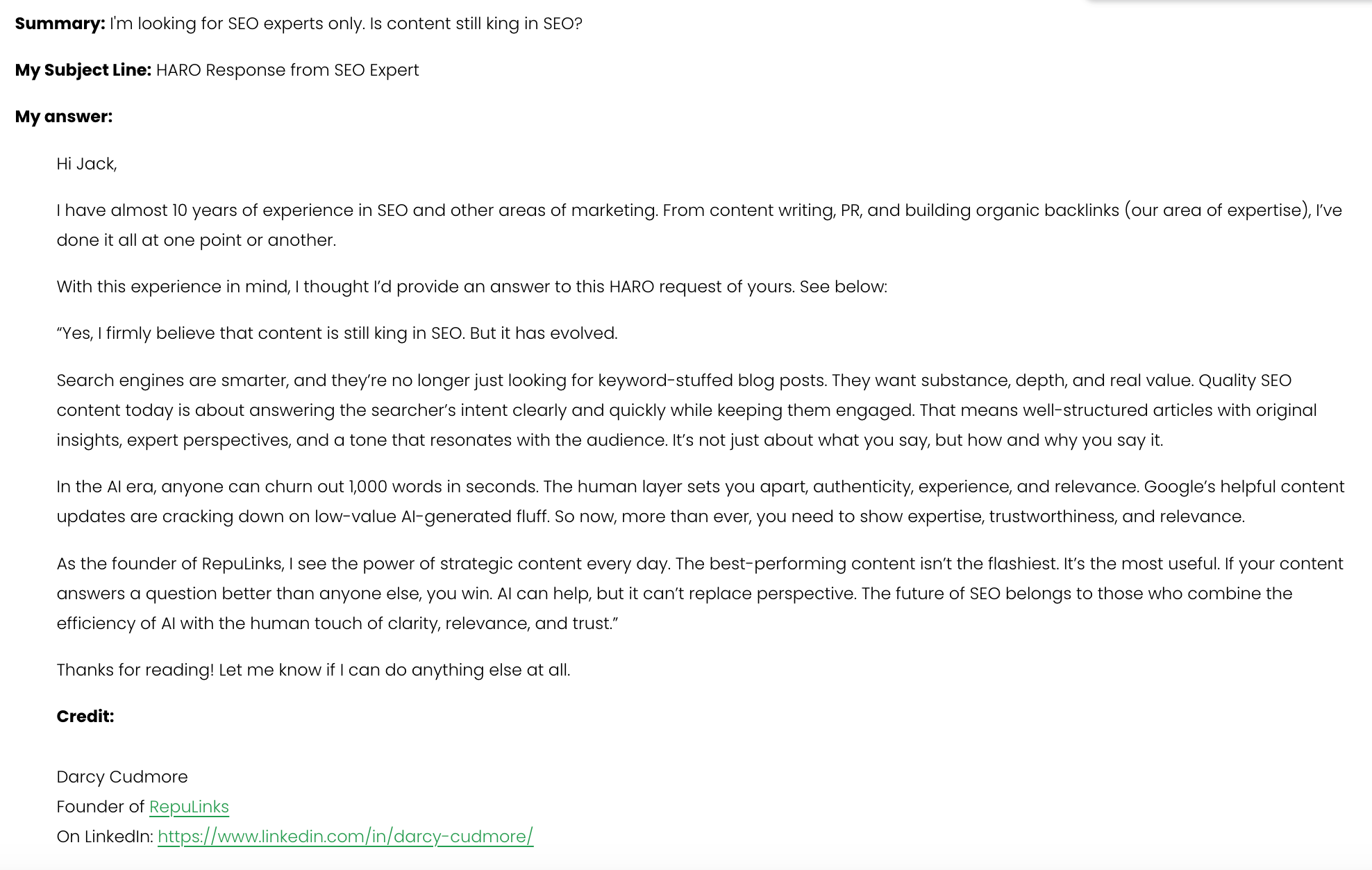
Now let’s break down why this pitch worked:
Clear subject line: “HARO Response from SEO Expert” is straightforward and relevant to the journalist's query. That's important, as they often use keywords to filter or scan a full inbox quickly.
Immediate credibility: “Almost 10 years in SEO” tells the journalist right away that this comes from someone qualified. I would say this is your first layer to truly stand out because, otherwise, they'd be wondering, "Why would I even listen to you?"
Direct answer comes early: See how I'm not stalling with my response? It answers the question immediately: “Yes… but it has evolved.” That first line alone is already quotable, which is exactly what journalists look for. It also leaves just enough intrigue to make them wonder, "Okay, how has it evolved?" and keep reading.
Specific, modern context: The pitch mentions AI content, search intent, and Google updates, all of which demonstrate an awareness of current trends. Journalists tend to value these kinds of timely insights because they make their articles more relevant to today's readers.
Concise and direct to the point: There's enough explanation to be useful without dragging things out and losing the journalist's attention. Every sentence adds something useful to the response.
Clean attribution at the end: The name, role, and website are clearly presented, making it easy for the journalist to verify the source and credit the contribution properly.
HARO Pitch Template You Can Use
Use this HARO pitch template as a starting point and adapt based on the journalist's query.
Subject Line: HARO Response – [Your Expertise]
Hi [Journalist Name],
I’m a [your role] with [X years] of experience in [specific area relevant to the query]. I’ve worked on [1 short credibility point e.g. clients, campaigns, niche].
[Direct answer to the question in 1-2 sentences. Make sure it is original, specific, and quotable]
[Expand with 2-4 short paragraphs]
Add explanation or reasoning
Include a specific example, scenario, or insight
Keep sentences tight and easy to quote
[Optional paragraph: one strong closing insight or takeaway]
Thanks for your time, happy to provide more if needed.
[Your Name]
[Your Position / Company]
[Link to website or profile]
How to Write a Successful HARO Pitch: Three Key Areas of Focus
The good thing about HARO is that it's free. Literally anyone can use it, which means anyone has a shot at earning high-quality backlinks and media mentions.
The problem? Ironically, it's the exact same thing: anyone can use it.
That means you're competing not only against people who genuinely have something valuable to contribute, but also against those churning out generic, zero-value responses at scale. With journalists already drowning in emails and having only so much time to review them, how do you stand out?
There are plenty of ways to approach HARO, but there are three principles we believe matter more than anything else. In fact, they're the same three principles we take seriously at RepuLinks and a big reason we've been able to consistently land high-authority backlinks.
Those three principles are as follows:
Speed
HARO queries typically remain open for a few days, but don't let that fool you into thinking you have plenty of time.
Within minutes of a query going live, journalists' inboxes can start filling up rapidly with responses. That's why it's important to secure valuable real estate early. Journalists only have so much time and patience, and given the sheer volume of pitches they receive, there's a good chance they won't even make it to the hundredth submission.
All that being said, even if a query isn't due for another three days, submitting within the first one to two hours can significantly improve your chances of getting noticed and selected.
As the saying goes, the early bird gets the worm.
Uniqueness
Remember, journalists use HARO because they're looking for fresh, original insights from real experts. After all, if the answer can be found with a quick Google search, what's the point of asking the question in the first place?
The more original, specific, and experience-driven your response is, the better your chances of standing out. Here are a few ways to do that:
Share specific experience: Talk about personal anecdotes, client stories, case studies, or lessons learned. These are things that AI and most competitors can't replicate.
State hard numbers or percentages: If you've conducted an internal study or tracked measurable results firsthand, use them. It doesn't get much more specific than citing your own data.
Offer more than just "text": For example, including images or infographics might be a bit unconventional, but honestly, I'm not totally opposed to it if it helps support your point or makes your response more useful. Just make sure to use a Google Drive or Dropbox link. Don't attach the image directly to the pitch, as it can take longer to load and create unnecessary friction for the journalist.
Conciseness
Here's a short exercise. Take a look at Examples A and B below.
Example A:
"I believe SEO is important for businesses because there are many different factors involved. Over the years, search engines have evolved significantly, and therefore businesses should consider implementing various strategies..."
Example B:
"SEO still works, but success today depends more on search intent, content quality, and authority than keyword stuffing."
Which response do you think has a better chance of being quoted?
If you answered example B, then bingo, you're right. It goes straight to the point and wastes no time making its case.
Remember, a HARO pitch is called a "pitch" after all, so make yours sound like one. Aim for around 150 to 200 words. If you absolutely need more room, I recommend capping it at around 250 words.
Remove fluff, unnecessary introductions, and anything that doesn't directly answer the question.
Tips to Improve Your HARO Pitch Success Rate
The trinity of speed, uniqueness, and conciseness will already put you ahead of most HARO contributors. But beyond those three principles, there are a few additional best practices that can further improve your chances of landing placements, picked up from years of writing successful HARO pitches.
Understand that not every pitch is worth going after.
You can only write so many quality pitches in a day before you start losing steam and your creative juices begin to dry up.
So, prioritize opportunities from publications that can actually move the needle instead of firing off twenty mediocre responses. You can use SEO tools like Ahrefs to evaluate metrics such as Domain Rating (DR) and estimate whether a publication is worth pursuing from a backlink perspective.
Always follow the journalist's instructions.
If the journalist tells you to include a specific keyword in the subject line, do so. Otherwise, you risk your pitch getting completely missed among hundreds of responses when the journalist filters or sorts through their inbox.
Keywords are just one example. You may also come across instructions regarding word count, formatting, credentials, or how they want responses submitted.
Regardless of what the instruction is, following it is professionalism 101. If you can't follow a simple request in the query, it doesn't exactly inspire confidence in the rest of your response.
Make your text 100% human-written.
Especially when you're dealing with writer's block, it can be tempting to let AI write the entire response for you. I advise against it, especially since HARO has already integrated Pangram, an AI-detection tool that can flag responses suspected of being AI-generated. If your pitch gets flagged, there's a big chance it may never make it to the cut.
Include credibility signals.
Always make it clear why you're qualified to answer the query. Early in the pitch, mention relevant experience, credentials, achievements, or even your location if the query calls for it.
Toward the end, include a short bio with your name, position, company, website, and ideally a business email address. The easier you make it for journalists to verify and trust you as a source, the better your chances of getting quoted.
Respond fast, but not too fast.
Yes, it's a good idea to submit your pitch early, as that can increase the chances of it getting noticed. But being too early, as in within-minutes early? That might raise a few eyebrows, especially among journalists who are super careful about vetting sources and maintaining quality.
That’s because it can give the impression that the response was pre-written, copied and pasted, or created with very little thought – and that's not exactly the impression you want to leave. As I mentioned earlier, the sweet spot is usually within the first one to two hours of the query going live.
Don't be overly promotional.
Focus on providing value and actually helping the journalist. As strange as this may sound, forget your motives for a moment. The promotion will come naturally if your pitch gets selected and you earn a backlink to your site.
Double-check for spelling and typographical errors.
Well, really, this goes for any professional piece of writing, but even more so for things like HARO pitches where your reputation is on the line. The reality is that it only takes one typo or spelling mistake to make you appear less professional, no matter how strong your insights may be. This is probably one of the best times to use AI and make it your proofreading partner – it's actually pretty good at that!
Be honest.
Don't exaggerate your experience, invent credentials, or pretend to know more than you actually do. Sorry Nike, but this is a definite "Just Don't Do It" situation.
Be patient.
Sometimes it's not your pitch, your writing, or your expertise. It could be as simple as the fact that the journalist may have hundreds of HARO responses sitting in their inbox but very little time to go through a fraction of them.
It can also come down to the niche. A query about B2B SaaS, a massive industry full of marketers, founders, and agencies fighting for coverage, is naturally going to attract far more responses than, say, ant collecting.
So if you don't get picked, don't immediately assume your pitch sucked. Sometimes the competition is just fierce, and that's part of the game.
That's also why I generally recommend diversifying your PR efforts instead of relying solely on HARO. If you're interested, we've put together a guide covering several HARO alternatives worth considering.
Want to Learn How We Secure HARO Backlinks Step by Step?
I've been speaking with founders, startups, and small business owners who are curious about HARO and want to learn how to turn it into a consistent source of high-quality backlinks and media placements.
If that sounds like you, book a FREE 1-on-1 consultation. I'll walk you through the exact process we use at RepuLinks so you can start landing HARO wins for yourself.
